SEO skills that still matter in AI era – Now, AI has significantly transformed the process of content creation. Nowadays, a blog post, a product description, a social media caption, or even an entire website can be produced within a couple of minutes thanks to AI technologies. While content creation has become very fast, it has resulted in a serious problem – the internet has been flooded with content that looks pretty similar.
That is why SEO skills are still needed.
Even though AI enables the creation of content on a large scale, simply publishing dozens of articles will not be sufficient. It is still up to the search engines to determine which piece of content is really valuable, relevant, informative, and beneficial to the user. Businesses and marketers who understand the basics of SEO can benefit from AI, but they should not be dictated by the technology in terms of their content strategy.
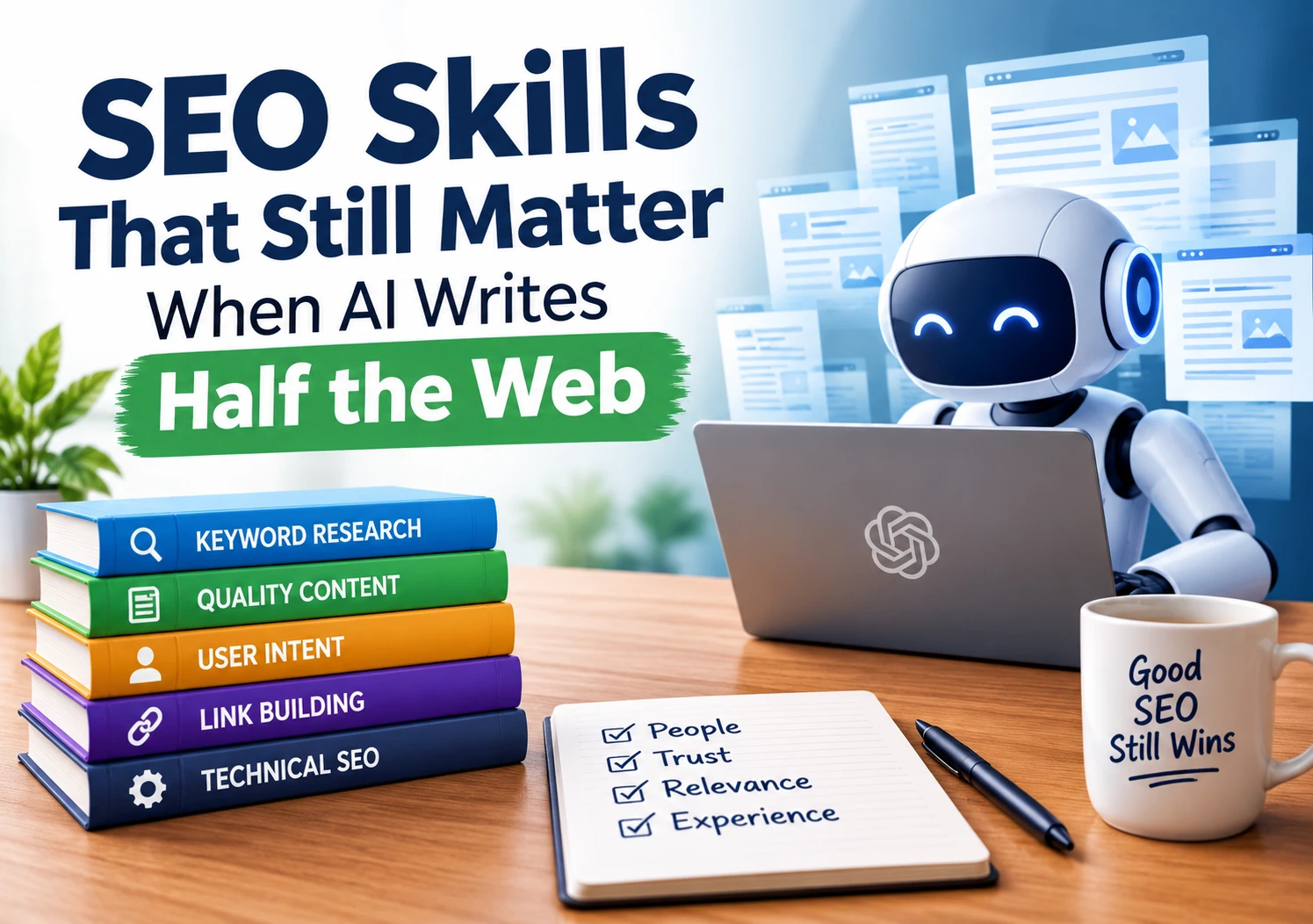
Here are the SEO skills that continue to be relevant even in the age of AI-written web content.
1. Understanding Search Intent
The understanding of the search intent is among the crucial SEO skills.
A keyword may seem very simple but the motivation behind a particular search is quite another thing. One person searching for “digital marketing course” can be interested in course details while the other may be comparing educational institutes, considering the cost of the program, or looking for a course nearby.
While AI can write an article based on a keyword, the understanding of the reason for which someone uses that keyword requires comprehensive research and proper judgment.
SEO specialists should understand the intent of the search and then create the content according to the needs of the user.
2. Smart Keyword Research
Keyword research did not lose its relevance due to AI. Instead, it became even more significant.
The point is that now SEOs do not just need to find keywords with high search volume. They have to understand the competition, relevance, the intent behind a keyword, related queries, long-tail keywords, and the existing content on the SERP.
For instance, instead of targeting a wide keyword such as “SEO course,” a marketer can use a narrow phrase like “SEO course for beginners,” “SEO course in Coimbatore,” “SEO course with placement,” or “SEO training in Coimbatore.”
While AI can generate keywords, SEO professionals have to choose which keywords they can really target.
3. Creating Content People Want to Read
AI can produce content free of grammatical errors within seconds. However, great SEO content is not limited to this quality.
The clarity of thought, usefulness, uniqueness, and understanding of answers are what people are looking for.
And here comes the role of human judgment. A person has to understand when he/she should give an example, clarify the material, share a story that would be useful for the reader, or cut some unnecessary details out.
If there are lots of websites that post AI-generated articles about the same topic, the one that gives the readers the experience and unique point of view will definitely be better.
4. The Importance of Technical SEO
Technical SEO works in the background but it makes a huge impact on the performance of a website in the search results.
Key aspects of technical SEO include:
- Website crawlability
- Indexation
- Site architecture
- Page speed
- Mobile responsiveness
- Internal linking
- XML sitemaps
- Canonical tags
- Structured data
- Broken links
AI can explain these concepts or even identify possible issues with a website but the implementation of technical SEO requires knowledge of how websites work.
A perfectly written article will not perform well if search engines cannot crawl or index a page properly.
5. Internal Linking and Website Structure
Internal linking is another SEO skill that can be overlooked when people get obsessed with AI-generated content.
A website should not be treated as a collection of individual blog posts. There has to be a logical connection between each page of the website.
For example, a blog post explaining “What is Technical SEO?” can contain links to website audits, keyword research, on-page SEO, and SEO services.
In addition, a well-crafted Internal linking not only helps users to get from one page to another but also helps search engines understand the relationship between different pages on your site.
6. Building Real Authority Through Links
Even though backlinks still play an essential role in SEO, the quality needs to come first rather than the quantity.
It will definitely not be efficient to write hundreds of substandard guest posts only for the purpose of gaining backlinks in the future. It would be much better to write the content that can be used as a reference on other sites.
Digital PR, original research, resources, expert opinions, industry studies, as well as quality content overall, can be a solid foundation of good backlinking strategy.
However, even though AI may assist with the research and planning, relationships and credibility still belong to humans.
7. Reading SEO Data Correctly
Another skill that AI cannot fully replace is the interpretation of the data.
SEO experts often have to work with information including:
- Organic traffic
- CTR
- Impressions
- Average position
- Conversion rate
- Bounce and engagement metrics
- Keyword rankings
- Backlinks data
A sudden fall in traffic does not mean necessarily that more content needs to be produced. There can be other reasons behind it – technical issues, change in the algorithm, the search behavior, seasonal demand, increased competition, etc.
Knowing the reason for the change is more valuable than the number itself.
8. Optimizing for People, Not Just Algorithms
SEO was always about connecting useful information with search engines but the user remains the main stakeholder of the strategy.
Filling up all the paragraphs with keywords has worked differently some years ago. Modern SEO requires natural language and genuinely useful information.
Instead of asking “how many times should I use this keyword?” it is better to ask “is this page able to offer more valuable answer to the user than alternative ones?”
That is how the whole approach will change significantly.
9. AI Use Without Developing a Dependence On AI
The smartest approach is not to refuse AI but to learn how to use it in the right way.
AI can be extremely useful for brainstorming topics, making content outlines, analysis of large data sets, identification of content gaps, generation of ideas, and improving productivity.
But SEO professionals should validate information, edit the work done by the AI, put their own insights into it, understand users’ search intentions, and make sure that the content is of help to the users.
Consider AI as an assistant and not as the one who is supposed to run the whole SEO campaign.
10. Staying Updated With Search Trends
Search is constantly changing. Algorithms evolve, the search behavior changes, and new search experiences keep appearing.
This makes it imperative for SEO professionals today to embrace a new environment.
Today’s SEO experts must be mindful of algorithm updates, changes in SERP, AI-assisted search behavior, quality requirements, analyzes trends, and optimization techniques.
While the basics will always be relevant, the manner of how the basics are utilized will always alter.
Learn Practical SEO Skills That Still Matter in AI Era With Khode Campus
For everyone who wants to learn SEO skills that still matter in AI era and develop them into a career skill, Khode Campus offers an opportunity to learn SEO with the practical approach. If you are looking for an SEO Course in Coimbatore, you will be able to learn everything from keyword research, on-page SEO, technical SEO, content strategy, link building, and SEO analytics.
Frequently Asked Questions
How is AI changing the future of SEO?
AI is making content creation and SEO research faster, but it is also increasing the amount of content available online. This means SEO professionals need to focus more on originality, user experience, content quality, authority, and strategic optimization.
Are SEO skills still important when AI can create content?
Yes. AI can help create content quickly, but SEO still requires human expertise in search intent, keyword research, technical optimization, content strategy, data analysis, and understanding what users actually need.
Can AI completely replace SEO professionals?
No. AI can automate several repetitive SEO tasks, but strategic decision-making still requires human judgment. SEO professionals need to understand business goals, users, competitors, search behavior, and website performance to create an effective SEO strategy.
How can AI be used effectively for SEO?
AI can assist with keyword ideas, content outlines, topic research, content briefs, competitor analysis, and identifying optimization opportunities. However, AI-generated information should be reviewed, fact-checked, edited, and enhanced with original insights before publishing.
Can beginners learn SEO without technical knowledge?
Yes. Beginners can learn many areas of SEO without coding experience. While basic technical knowledge is helpful for technical SEO, skills such as keyword research, content optimization, search intent, competitor analysis, and SEO reporting can be learned without advanced programming knowledge.
What SEO skills should beginners learn first?
Beginners should start with keyword research, search intent, on-page SEO, technical SEO basics, content optimization, internal linking, and SEO analytics. Building a strong foundation in these areas makes it easier to understand more advanced SEO strategie